Studies the anatomy, physiology, biochemistry and ecology of plants.
Occupation description
Studies the anatomy, physiology, biochemistry and ecology of plants.
Occupations considered suitable under this ANZSCO code:
- Plant Pathologist
- Plant Physiologist
- Plant Taxonomist
Botanist is a VETASSESS Group A occupation
This occupation requires a qualification assessed as comparable to the educational level of an Australian Qualifications Framework (AQF) Bachelor degree or higher, in a field highly relevant to the nominated occupation.
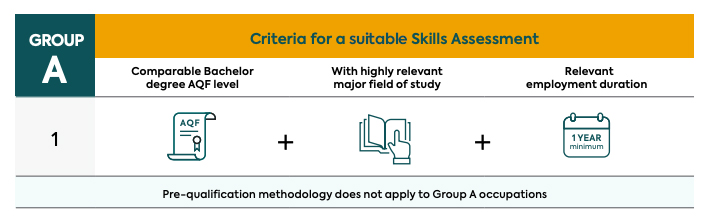
The information below describes the available pathways for a Skills Assessment under Group A. Please note that in order to achieve a suitable Skills Assessment Outcome, a suitable assessment for both qualifications and employment is required.
Pathway 1
This pathway requires a qualification assessed as comparable to the education level of an Australian Qualifications Framework (AQF) Bachelor degree or higher degree and in a field highly relevant to the nominated occupation.
Bachelor degree or higher degree includes AQF Master Degree or AQF Doctoral Degree.
In addition, it is essential for applicants to meet the following employment criteria:
- at least one year of post-qualification employment at an appropriate skill level, undertaken in the last five years,
- working 20 hours or more per week, and
- highly relevant to the nominated occupation.
Qualification & Employment Criteria
Qualification
Botany is the scientific study of plants, related microbial organisms, plant habitats and ecosystem relations.
Subjects in this field include:
• Organisation and Function of Cells and Organisms
• Plant Anatomy and Structure
• Plant Morphology and Physiology
• Plant Molecular Biology
• Plant Genetics
• Plant Nutrition
• Ecosystems
• Phytochemistry
• Cytology
• Plant Taxonomy and Systematics
• Palaeobotany
• Biophysics and Molecular Biology
• Plant Ecology
• Field and Environmental Botany
• Plant Biotechnology
• Microbial Organisms
• Plant Histology
• Plant Morphology
• Plant Physiology
• Herbology
Employment Criteria
Highly relevant tasks include, but are not limited to:
- Grows plants under controlled conditions to determine optimum environmental factors, assess the significance of environmental and genetic variables, and examine patterns of plant evolution
- Studies the nature and occurrence of plant chromosomes, cells and tissues
- Makes field and laboratory studies of plant groups to compile and revise natural classifications
- May prepare handbooks for identification of plants
- May supervise and coordinate the work of technical officers and technicians
- May search for, identify and classify new species of plants
- May work with other scientists to develop drugs, medicines and other products from plants
Additional tasks may include:
- Planning and undertaking experiments to study, measure and understand plants
- Designing and conducting experiments, making observations and measurements, researching information, analysing data, preparing or supervising the preparation of laboratory reports and scientific papers, presenting findings at scientific meetings and conferences, and supervising the work of staff
- Investigating the chemical structure and function of living cells and their isolated components, organs and tissues in plants
- Investigating the effects of environmental factors, such as rainfall, temperature, sunlight, soil, topography and disease, on plant growth
Get Support
Help with a Skills Assessment
Skills Assessment Support (SAS) services are for migration agents, legal practitioners and prospective applicants who are yet to submit their Skills Assessment application to VETASSESS.
Help with an urgent application
For general and professional occupations, priority processing can be used to fast-track urgent applications
How to apply
If you're a professional choosing to migrate to Australia, chances are you're likely to be assessed by us. We assess 361 different professional occupations, assessing your skills, experience and qualifications.
Find
Find the VETASSESS occupation that most closely fits your skills and experience.
Match
Match your skills and experience to your chosen occupation.
Prepare
Get ready to apply by preparing all the information and documents you need.
Apply
Apply online when you’re ready. If you’re still unsure, skills assessment support is available when you need it.