Develops and implements programs and regulations for the protection of fish, wildlife and other natural resources.
Occupation description
Develops and implements programs and regulations for the protection of fish, wildlife and other natural resources.
Occupations considered suitable under this ANZSCO code:
- Landcare Facilitator
Conservation Officer is a VETASSESS Group A occupation
This occupation requires a qualification assessed as comparable to the educational level of an Australian Qualifications Framework (AQF) Bachelor degree or higher, in a field highly relevant to the nominated occupation.
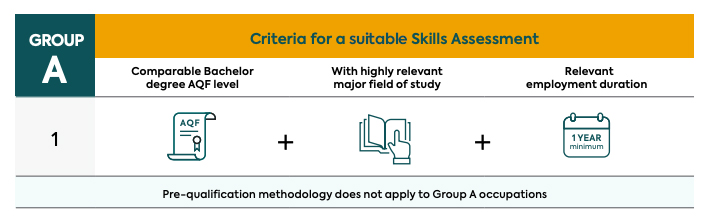
The information below describes the available pathways for a Skills Assessment under Group A. Please note that in order to achieve a suitable Skills Assessment Outcome, a suitable assessment for both qualifications and employment is required.
Pathway 1
This pathway requires a qualification assessed as comparable to the education level of an Australian Qualifications Framework (AQF) Bachelor degree or higher degree and in a field highly relevant to the nominated occupation.
Bachelor degree or higher degree includes AQF Master Degree or AQF Doctoral Degree.
In addition, it is essential for applicants to meet the following employment criteria:
- at least one year of post-qualification employment at an appropriate skill level, undertaken in the last five years,
- working 20 hours or more per week, and
- highly relevant to the nominated occupation.
Qualification & Employment Criteria
Qualification
Agricultural Science is the study of the non-intensive farming of animals and plants.
Environmental Studies is the study of the relationships between living organisms and the natural, rural, industrial and urban environments. It includes the study of the impact humans have upon the natural environment.
Subjects in Agricultural Science include:
• Agricultural Systems
• Agronomy
• Cells and Organisms
• Chemistry
• Plant and Animal Production and Management
• Plant Science
• Plant Cultivation
• Crop Production
• Crop Science
• Broad Acre Production
• Dryland Farming Systems
• Grazing Systems
• Animal Science
• Animal Husbandry
• Animal Nutrition
• Dairying
• Soil Science
• Soil Conservation
• Environmental Impact and Assessment
• Soil and Water Conservation
• Aquatic Resource Management
• Land and Soil Management
• Agricultural Technology
• Statistics
• Business Law
• Agribusiness
• Agricultural Economics
• Marketing
Subjects in Environmental Studies include:
• Environmental Science
• Biodiversity and Ecology
• Natural Vegetation and Wildlife
• Weather and Climate
• Environment, Technology and Sustainability
• Environmental Management
• Land and Water Management
• Land Conservation
• Soil Conservation
• Land Rehabilitation
• Irrigation
• Natural Resource Inventory and Appraisal
• Environmental Impact Assessment
• Flora and Fauna Management
• Fumigation Techniques
• Integrated Pest and Weed Control
• Pest and Weed Identification
• Plant Disease Control
• Plant Protection Programmes
• Mathematics
• Methods and Statistics
• Physics
• Chemistry
• Cell Biology
• Scientific Research Methods
• Geographical Information Systems
Employment Criteria
Highly relevant tasks include, but are not limited to:
- Studies the effects on animal and plant life of such factors as terrain, altitude, climatic conditions, sources of nutrition, and predators
- Investigates the structure of communities of organisms and predicts the effects of disturbances by human or environmental changes
- Plans and conducts field trips to study animals and plants in their natural environments and to collect specimens for laboratory study
- Prepares graphs, charts and statistics from data, analyses data and correlates them with the work of other scientists, evaluates data and prepares reports of conclusions
- Develops and tests models of the environment using knowledge of ecology, mathematics, statistics and physical sciences
- Develops conservation or harvesting policies for management of biological resources such as fish populations and forests
- Assesses pollution problems, establishes standards and develops approaches for the control of pollution and the rehabilitation of areas disturbed by activities such as mining, timber felling or overgrazing
Additional tasks include
- Evaluating habitat, wildlife and fisheries needs, and formulating short- and long-term management goals and objectives
- Enforcing laws and regulations to conserve and protect fish and wildlife
Get Support
Help with a Skills Assessment
Skills Assessment Support (SAS) services are for migration agents, legal practitioners and prospective applicants who are yet to submit their Skills Assessment application to VETASSESS.
Help with an urgent application
For general and professional occupations, priority processing can be used to fast-track urgent applications
How to apply
If you're a professional choosing to migrate to Australia, chances are you're likely to be assessed by us. We assess 361 different professional occupations, assessing your skills, experience and qualifications.
Find
Find the VETASSESS occupation that most closely fits your skills and experience.
Match
Match your skills and experience to your chosen occupation.
Prepare
Get ready to apply by preparing all the information and documents you need.
Apply
Apply online when you’re ready. If you’re still unsure, skills assessment support is available when you need it.