Collects and tests earth and water samples, records observations and analyses data in support of Geologists or Geophysicists.
Occupation description
Collects and tests earth and water samples, records observations and analyses data in support of Geologists or Geophysicists.
Occupations considered suitable under this ANZSCO code:
- Earth Science Laboratory Technician
- Geochemical Laboratory Technician
- Geological Technical Officer
- Geoscience Laboratory Technician
- Hydrographer
- Hydrographical Technical Officer
- Hydrological Technical Officer
- Meteorological Observer
- Seismology Technical Officer
- Soil Science Technical Officer
- Water Resources Technical Officer
This occupation requires a qualification assessed as comparable to the educational level of an Australian Qualifications Framework (AQF) Diploma or higher. Applicants can fulfil the assessment criteria for this occupation in four different ways.
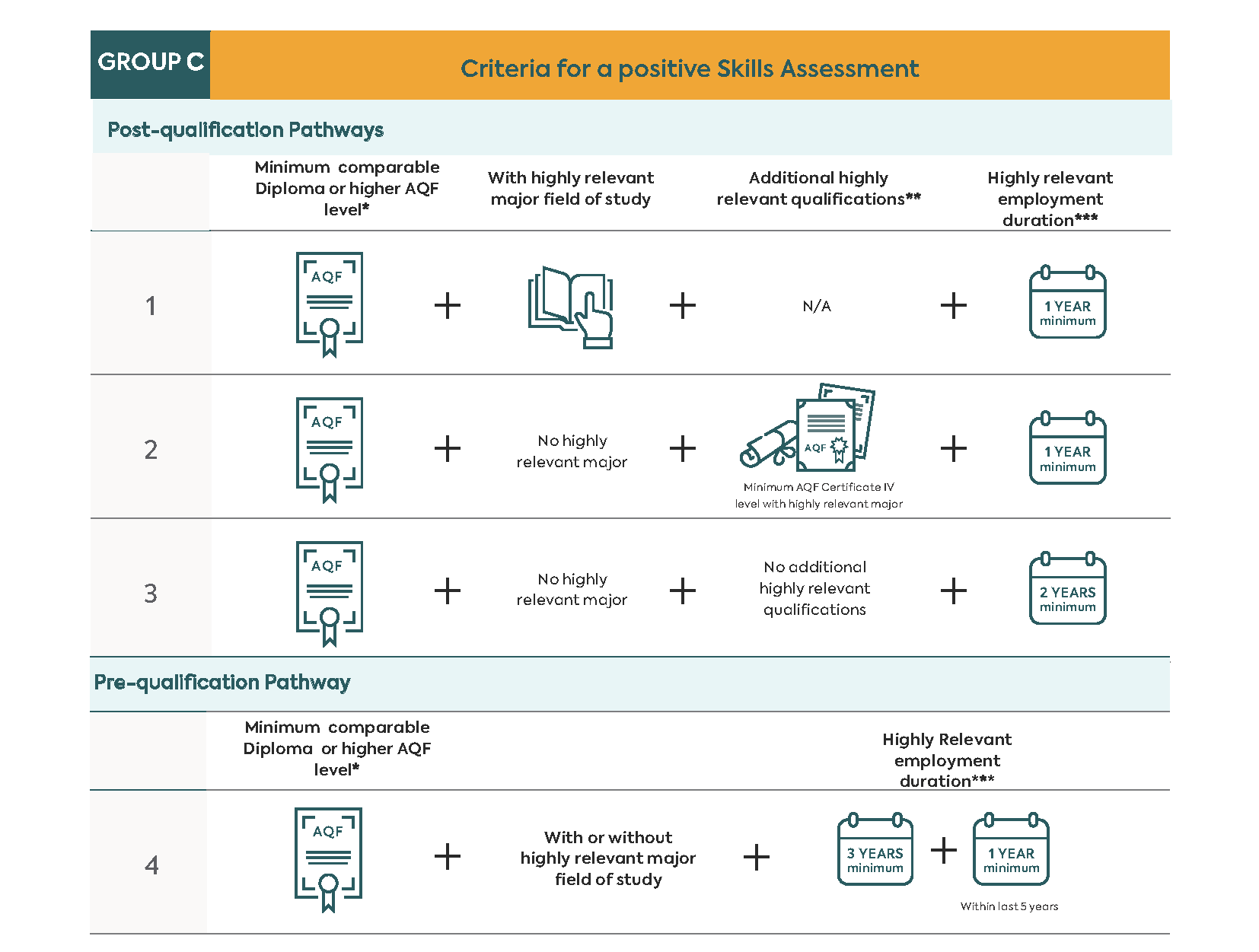
Description of Pathways
The information below describes the available pathways for a Skills Assessment under Group C. Please note that in order to achieve a successful Skills Assessment Outcome, a suitable assessment for both qualifications and employment is required.
Pathway 1
This pathway requires a qualification assessed as comparable to the education level of an Australian Qualifications Framework (AQF) Diploma or higher and in a field highly relevant to the nominated occupation.
Diploma or higher includes AQF Advanced Diploma, Associate Degree, Bachelor Degree, Graduate Diploma, Master Degree or Doctoral Degree.
In addition, it is essential for applicants to meet the following employment criteria:
- at least one year of post-qualification employment at an appropriate skill level, undertaken in the last five years,
- working 20 hours or more per week, and
- highly relevant to the nominated occupation.
Pathway 2
This pathway requires a qualification assessed as comparable to the education level of an Australian Qualifications Framework (AQF) Diploma or higher and in a field not highly relevant to the nominated occupation.
Diploma or higher includes AQF Advanced Diploma, Associate Degree, Bachelor Degree, Graduate Diploma, Master Degree or Doctoral Degree.
An additional qualification in a highly relevant field of study at a minimum AQF Certificate IV level is required. Additional qualifications in a highly relevant field of study include those comparable to the AQF Certificate IV.
In addition, it is essential for applicants to meet the following employment criteria:
- at least one year of post-qualification employment at an appropriate skill level, undertaken in the last five years,
- working 20 hours or more per week, and
- highly relevant to the nominated occupation.
For example, an applicant for the occupation Program or Project Administrator completed a non-relevant AQF Diploma qualification in April 2024 and later completed an AQF Certificate IV in Project Management in May 2026. The applicant commenced employment with the organisation in May 2024 and remains employed there.
Under Pathway 2, the applicant satisfies the minimum educational requirement for a Group C occupation through the AQF Diploma qualification. Accordingly, employment is counted from the completion date of the Diploma qualification, meaning employment from May 2024 onwards may be considered toward both the required Qualifying Period (QP) and any remaining eligible period for the points test.
As the later Certificate IV qualification is highly relevant to the occupation, the applicant may access the reduced employment requirement applicable under Pathway 2. In this case, only one year of QP is required, and that employment may be counted from the post-Diploma period rather than from the Certificate IV qualification completion date.
Pathway 3
This pathway requires a qualification assessed as comparable to the education level of an Australian Qualifications Framework (AQF) Diploma or higher and in a field not highly relevant to the nominated occupation.
Diploma or higher includes AQF Advanced Diploma, Associate Degree, Bachelor Degree, Graduate Diploma, Master Degree or Doctoral Degree.
In addition, it is essential for applicants to meet the following employment criteria:
- at least two years of post-qualification employment at an appropriate skill level, undertaken in the last five years,
- working 20 hours or more per week, and
- highly relevant to the nominated occupation.
Pathway 4
This pathway requires a qualification assessed as comparable to the education level of an Australian Qualifications Framework (AQF) Diploma or higher with or without a highly relevant major field of study to the nominated occupation.
Diploma or higher includes AQF Advanced Diploma, Associate Degree, Bachelor Degree, Graduate Diploma, Master Degree or Doctoral Degree.
In addition, it is essential for applicants to meet the following employment criteria:
- at least four years of employment at an appropriate skill level that includes at least one year of highly relevant employment within the last five years before applying,
- working 20 hours or more per week, and
- highly relevant to the nominated occupation.
Qualification & Employment Criteria
Qualification
Laboratory Technology is a field of study which provides training for personnel to provide para-professional support in a wide range of scientific laboratories.
PML50104 Diploma in Laboratory Technology within the Laboratory Operations Training Package PML04 includes core units and electives:
Core units:
- Communicate with other people
- Provide information to customers
- Process and interpret data
- Analyse data and report results
- Use laboratory application software
- Maintain laboratory/field workplace safety
- Plan and conduct laboratory/field work
- Apply quality system and continuous improvement processes
Electives may be viewed in the PMLO4 Training Package on the NTIS website.
Geoscience is the study of the physical properties of the Earth’s crust and the characteristics of its soil, landforms, climate, hydrosphere and atmosphere.
Subjects in this field include:
- Atmospheric Stability, Moisture and Motion
- Climatology
- Meteorology
- Coastal and Marine Geoscience
- Sedimentology
- Mineralogy
- Petrology
- Tectonics
- Volcanology
- Electrical Properties of Rocks and Minerals
- Geomagnetism
- Petrophysics
- Seismology
- Hydrogeochemistry
- Sediment Geochemistry
- Soil Nutrient and Water Supply
- Soils in the Landscape
- The Soil Environment
- Soil Mineralogy
- Flood Estimation Models and Procedures
- Groundwater Modelling
- Water Catchments
- Water Resources
- Chemical and Physical Properties of Seawater
- Currents, Waves and Tides
- Ocean Floor Topography
- Physical Geography
- Chemistry
- Mathematics
- Physics
- Biology
Employment Criteria
Highly relevant tasks include, but are not limited to:
- Collecting information and samples
- Conducting field and laboratory experiments, tests and analyses
- Presenting results in graphic and written form by preparing maps, charts, sketches, diagrams and reports
Additional tasks may include:
- Collects and collates information from geological field surveys, seismic surveys, meteorological observations and other earth science surveys
- Prepares and tests samples
- Analyses data using methodologies prescribed by earth scientists to interpret survey results
- Checks, calibrates and maintains testing equipment
- May investigate various geographical, geophysical or geological specialties such as water resources, climate and weather, mineral extraction, magnetic measures or gravity measurement
Get Support
Help with a Skills Assessment
Skills Assessment Support (SAS) services are for migration agents, legal practitioners and prospective applicants who are yet to submit their Skills Assessment application to VETASSESS.
Help with an urgent application
For general and professional occupations, priority processing can be used to fast-track urgent applications
How to apply
If you're a professional choosing to migrate to Australia, chances are you're likely to be assessed by us. We assess 361 different professional occupations, assessing your skills, experience and qualifications.
Find
Find the VETASSESS occupation that most closely fits your skills and experience.
Match
Match your skills and experience to your chosen occupation.
Prepare
Get ready to apply by preparing all the information and documents you need.
Apply
Apply online when you’re ready. If you’re still unsure, skills assessment support is available when you need it.