Flying Instructor teaches the theory and practical skills of flying aircraft. Registration or licensing is required.
Occupation description
Flying Instructor teaches the theory and practical skills of flying aircraft. Registration or licensing is required.
Occupations considered suitable under this ANZSCO code:
- Helicopter Pilot Instructor
- Gliding Pilot Instructor
This occupation requires a qualification assessed as comparable to the educational level of an Australian Qualifications Framework (AQF) Bachelor degree or higher.
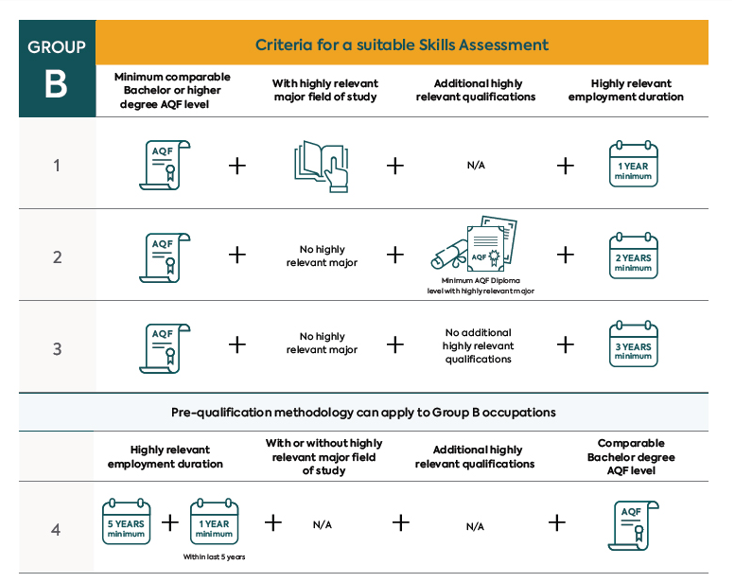
Applicants must have fulfilled at least one of the following four criteria (1–4):
Description of Pathways
The information below describes the available pathways for a Skills Assessment under Group B. Please note that in order to achieve a suitable Skills Assessment Outcome, a positive assessment for both qualifications and employment is required.
Pathway 1
This pathway requires a qualification assessed as comparable to the education level of an Australian Qualifications Framework (AQF) Bachelor degree or higher degree and in a field highly relevant to the nominated occupation.
Bachelor degree or higher degree includes AQF Master Degree or AQF Doctoral Degree.
In addition, it is essential for applicants to meet the following employment criteria:
- at least one year of post-qualification employment at an appropriate skill level, undertaken in the last five years,
- working 20 hours or more per week, and
- highly relevant to the nominated occupation.
Pathway 2
This pathway requires a qualification assessed as comparable to the education level of an Australian Qualifications Framework (AQF) Bachelor degree or higher degree and in a field not highly relevant to the nominated occupation.
Bachelor degree or higher degree includes AQF Master Degree or AQF Doctoral Degree.
An additional qualification in a highly relevant field of study at a minimum AQF Diploma level is required. Additional qualifications in a highly relevant field of study include those comparable to the AQF Diploma or AQF Advanced Diploma or AQF Associate Degree or AQF Graduate Diploma.
In addition, it is essential for applicants to meet the following employment criteria:
- at least two years of post-qualification employment at an appropriate skill level, undertaken in the last five years,
- working 20 hours or more per week, and
- highly relevant to the nominated occupation.
For example, an applicant for the occupation Quality Assurance Manager completed a non-relevant AQF Bachelor qualification in April 2024 and later completed an AQF Diploma in Quality Management in May 2026. The applicant commenced employment with the organisation in May 2024 and remains employed there.
Under Pathway 2, the applicant satisfies the minimum educational requirement for a Group B occupation through the AQF Bachelor qualification. Accordingly, employment is counted from the completion date of the Bachelor qualification, meaning employment from May 2024 onwards may be considered toward both the required Qualifying Period (QP) and any remaining eligible period for the points test.
As the later Diploma qualification is highly relevant to the occupation, the applicant may access the reduced employment requirement applicable under Pathway 2. In this case, only two years of QP are required, and that employment may be counted from the post-Bachelor period rather than from the Diploma qualification completion date.
Pathway 3
This pathway requires a qualification assessed as comparable to the education level of an Australian Qualifications Framework (AQF) Bachelor degree or higher degree and in a field not highly relevant to the nominated occupation.
Bachelor degree or higher degree includes AQF Master Degree or AQF Doctoral Degree.
In addition, it is essential for applicants to meet the following employment criteria:
- at least three years of post-qualification employment at an appropriate skill level, undertaken in the last five years,
- working 20 hours or more per week, and
- highly relevant to the nominated occupation.
Pathway 4
This pathway requires a qualification assessed as comparable to the education level of an Australian Qualifications Framework (AQF) Bachelor degree or higher degree with or without a highly relevant major field of study to the nominated occupation.
Bachelor degree or higher degree includes AQF Master Degree or AQF Doctoral Degree.
In addition, it is essential for applicants to meet the following employment criteria:
- at least six years of employment at an appropriate skill level that includes at least one year of highly relevant employment within the last five years before applying,
- working 20 hours or more per week, and
- highly relevant to the nominated occupation.
Qualification & Employment Criteria
Qualification
Flight instruction is a program of study that focuses on the technical knowledge and skills to train pilots to a level which is required to obtain a private or commercial pilot’s licence for fixed or rotary wing aircraft.
This occupation requires a qualification assessed as comparable to the education level of an Australian Qualifications Framework (AQF) Bachelor degree or higher degree and in a field highly relevant to the nominated occupation.
Employment Criteria
Relevant tasks include, but are not limited to:
- Develops course outlines, lesson plans and resource materials
- Lectures, demonstrates and provides practical exercises for students
- Instructs in the operation of communications, navigational and meteorological equipment
- Teaches use of aircraft controls and instruments
- Teaches operational considerations such as airframe construction characteristics and engine performance
- Demonstrates the use of safety equipment and pre-flight inspection of aircraft
- Gives in-flight instruction, supervises solo flights, accompanies students on training flights and demonstrates techniques for controlling aircraft during taxiing, take off, turns and landings
- Tests students' proficiency using written, theoretical, practical and verbal examination techniques
- Makes recommendation for examining and licensing at end of training
- May give post-licensing rating and endorsement training to student and qualified pilots
Get Support
Help with a Skills Assessment
Skills Assessment Support (SAS) services are for migration agents, legal practitioners and prospective applicants who are yet to submit their Skills Assessment application to VETASSESS.
Help with an urgent application
For general and professional occupations, priority processing can be used to fast-track urgent applications
How to apply
If you're a professional choosing to migrate to Australia, chances are you're likely to be assessed by us. We assess 361 different professional occupations, assessing your skills, experience and qualifications.
Find
Find the VETASSESS occupation that most closely fits your skills and experience.
Match
Match your skills and experience to your chosen occupation.
Prepare
Get ready to apply by preparing all the information and documents you need.
Apply
Apply online when you’re ready. If you’re still unsure, skills assessment support is available when you need it.