A Metallurgical or Materials Technician tests materials as part of mineral and metal processing and refining, or for research into metals, ceramics, polymers and other materials in support of Metallurgists and Materials Engineers.
Occupation description
A Metallurgical or Materials Technician tests materials as part of mineral and metal processing and refining, or for research into metals, ceramics, polymers and other materials in support of Metallurgists and Materials Engineers.
Occupations considered suitable under this ANZSCO code:
- Dye Penetrant Testing Technician
- Heat Treatment Technician
- Magnetic Testing Technician
- Metallurgy Laboratory Technician
- Non-destructive Testing Technician
- Petroleum Products Laboratory Technician
- Petroleum Refinery Laboratory Technician
- Pressure Testing Technician
- Ultrasound Technician
Occupations not considered under this ANZSCO code:
- Metallurgist
These occupations are classified elsewhere in ANZSCO or are not at the required skill level.
Metallurgical or Materials Technician is a VETASSESS Group C occupation
This occupation requires a qualification assessed as comparable to the educational level of an Australian Qualifications Framework (AQF) Diploma or higher.
Applicants must have fulfilled at least one of the following four criteria (1-4):
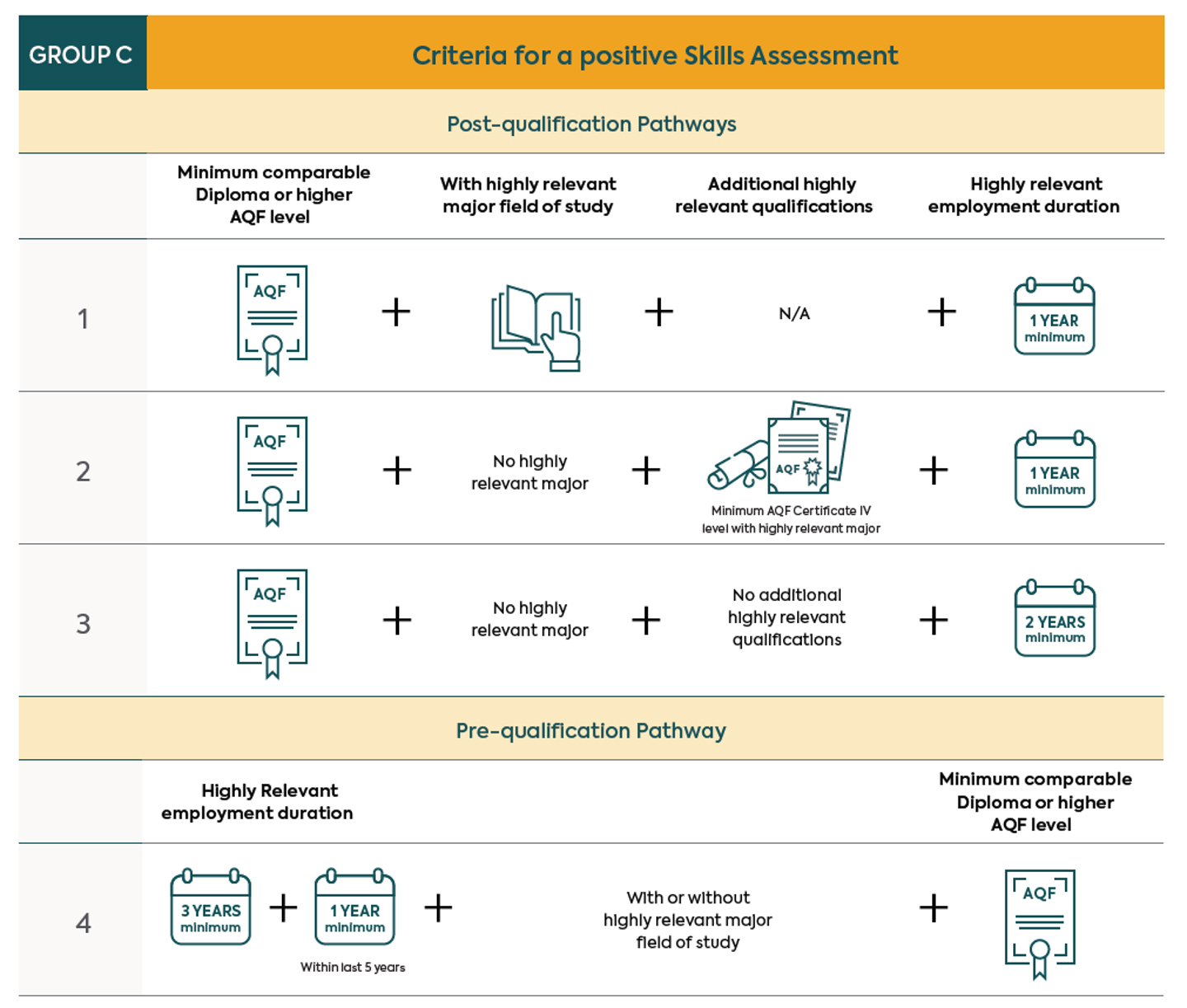
Description of Pathways
The information below describes the available pathways for a Skills Assessment under Group C. Please note that in order to achieve a successful Skills Assessment Outcome, a suitable assessment for both qualifications and employment is required.
Pathway 1
This pathway requires a qualification assessed as comparable to the education level of an Australian Qualifications Framework (AQF) Diploma or higher and in a field highly relevant to the nominated occupation.
Diploma or higher includes AQF Advanced Diploma, Associate Degree, Bachelor Degree, Graduate Diploma, Master Degree or Doctoral Degree.
In addition, it is essential for applicants to meet the following employment criteria:
- at least one year of post-qualification employment at an appropriate skill level, undertaken in the last five years,
- working 20 hours or more per week, and
- highly relevant to the nominated occupation.
Pathway 2
This pathway requires a qualification assessed as comparable to the education level of an Australian Qualifications Framework (AQF) Diploma or higher and in a field not highly relevant to the nominated occupation.
Diploma or higher includes AQF Advanced Diploma, Associate Degree, Bachelor Degree, Graduate Diploma, Master Degree or Doctoral Degree.
An additional qualification in a highly relevant field of study at a minimum AQF Certificate IV level is required. Additional qualifications in a highly relevant field of study include those comparable to the AQF Certificate IV.
In addition, it is essential for applicants to meet the following employment criteria:
- at least one year of post-qualification employment at an appropriate skill level, undertaken in the last five years,
- working 20 hours or more per week, and
- highly relevant to the nominated occupation.
For example, an applicant for the occupation Program or Project Administrator completed a non-relevant AQF Diploma qualification in April 2024 and later completed an AQF Certificate IV in Project Management in May 2026. The applicant commenced employment with the organisation in May 2024 and remains employed there.
Under Pathway 2, the applicant satisfies the minimum educational requirement for a Group C occupation through the AQF Diploma qualification. Accordingly, employment is counted from the completion date of the Diploma qualification, meaning employment from May 2024 onwards may be considered toward both the required Qualifying Period (QP) and any remaining eligible period for the points test.
As the later Certificate IV qualification is highly relevant to the occupation, the applicant may access the reduced employment requirement applicable under Pathway 2. In this case, only one year of QP is required, and that employment may be counted from the post-Diploma period rather than from the Certificate IV qualification completion date.
Pathway 3
This pathway requires a qualification assessed as comparable to the education level of an Australian Qualifications Framework (AQF) Diploma or higher and in a field not highly relevant to the nominated occupation.
Diploma or higher includes AQF Advanced Diploma, Associate Degree, Bachelor Degree, Graduate Diploma, Master Degree or Doctoral Degree.
In addition, it is essential for applicants to meet the following employment criteria:
- at least two years of post-qualification employment at an appropriate skill level, undertaken in the last five years,
- working 20 hours or more per week, and
- highly relevant to the nominated occupation.
Pathway 4
This pathway requires a qualification assessed as comparable to the education level of an Australian Qualifications Framework (AQF) Diploma or higher with or without a highly relevant major field of study to the nominated occupation.
Diploma or higher includes AQF Advanced Diploma, Associate Degree, Bachelor Degree, Graduate Diploma, Master Degree or Doctoral Degree.
In addition, it is essential for applicants to meet the following employment criteria:
- at least four years of employment at an appropriate skill level that includes at least one year of highly relevant employment within the last five years before applying,
- working 20 hours or more per week, and
- highly relevant to the nominated occupation.
Qualification and Employment Criteria
Employment
Highly relevant tasks include, but are not limited to:
- Testing materials as part of mineral and metal processing and refining.
- Conducting mineral research for application to study of metals, ceramics, polymers and other materials in support of Metallurgist and Materials Engineers.
Additional tasks may include:
- Subjecting materials to test procedures often using complex equipment under the direction of metallurgists and other professionals.
- Analysing, recording and reporting results.
- Setting up, operating and cleaning laboratory and other scientific equipment.
- Conducting studies of metals and alloys before and during processing to determine their properties.
- Working out temperature adjustments, raw material mixtures and other processing variables to make metals.
Employment information
For the occupation of Metallurgical or Materials Technician, applicants are required to demonstrate employment in a role that is primarily focused on performing testing, analysis or research tasks regarding metals or synthetic materials. As this is a technician skill level occupation, it is important to note the distinction between Metallurgical or Materials Technicians and the separate occupation of Metallurgist (ANZSCO Code 234912).
Categories of acceptable employment contexts include (but are not limited to):
- Mining sites
- Metal refineries
- Technical services providers
- External testing certification companies
For employment undertaken in a commercial manufacturing plant setting, employment may be considered relevant if there is clear evidence that the applicant performs the above-mentioned tasks in relation to product development, research, process improvement or quality control activities. However, experience in performing day-to-day production line activities within such a context would not be deemed relevant to this occupation.
Supporting material for assessment
When applying for a Skills Assessment, please ensure you submit sufficient evidence supporting proof of identity, qualification and employment claims. Applicants nominating this occupation are required to provide evidence in line with VETASSESS documentation requirements (see List of Required Documents).
Get Support
Help with a Skills Assessment
Skills Assessment Support (SAS) services are for migration agents, legal practitioners and prospective applicants who are yet to submit their Skills Assessment application to VETASSESS.
Help with an urgent application
For general and professional occupations, priority processing can be used to fast-track urgent applications
How to apply
If you're a professional choosing to migrate to Australia, chances are you're likely to be assessed by us. We assess 361 different professional occupations, assessing your skills, experience and qualifications.
Find
Find the VETASSESS occupation that most closely fits your skills and experience.
Match
Match your skills and experience to your chosen occupation.
Prepare
Get ready to apply by preparing all the information and documents you need.
Apply
Apply online when you’re ready. If you’re still unsure, skills assessment support is available when you need it.