An Office Manager organises and controls the functions and resources of an office such as administrative systems and office personnel.
Occupation description
An Office Manager organises and controls the functions and resources of an office such as administrative systems and office personnel.
Occupations not considered under this ANZSCO code:
- Receptionists (ANZSCO Unit Group 5421)
- Practice Managers (ANZSCO Unit Group 5122)
- Personal Assistants (ANZSCO Unit Group 5211)
- Secretaries (ANZSCO Unit Group 5212)
These occupations are classified elsewhere in ANZSCO.
Office Manager is a VETASSESS Group C occupation
This occupation requires a qualification assessed as comparable to the educational level of an Australian Qualifications Framework (AQF) Diploma or higher.
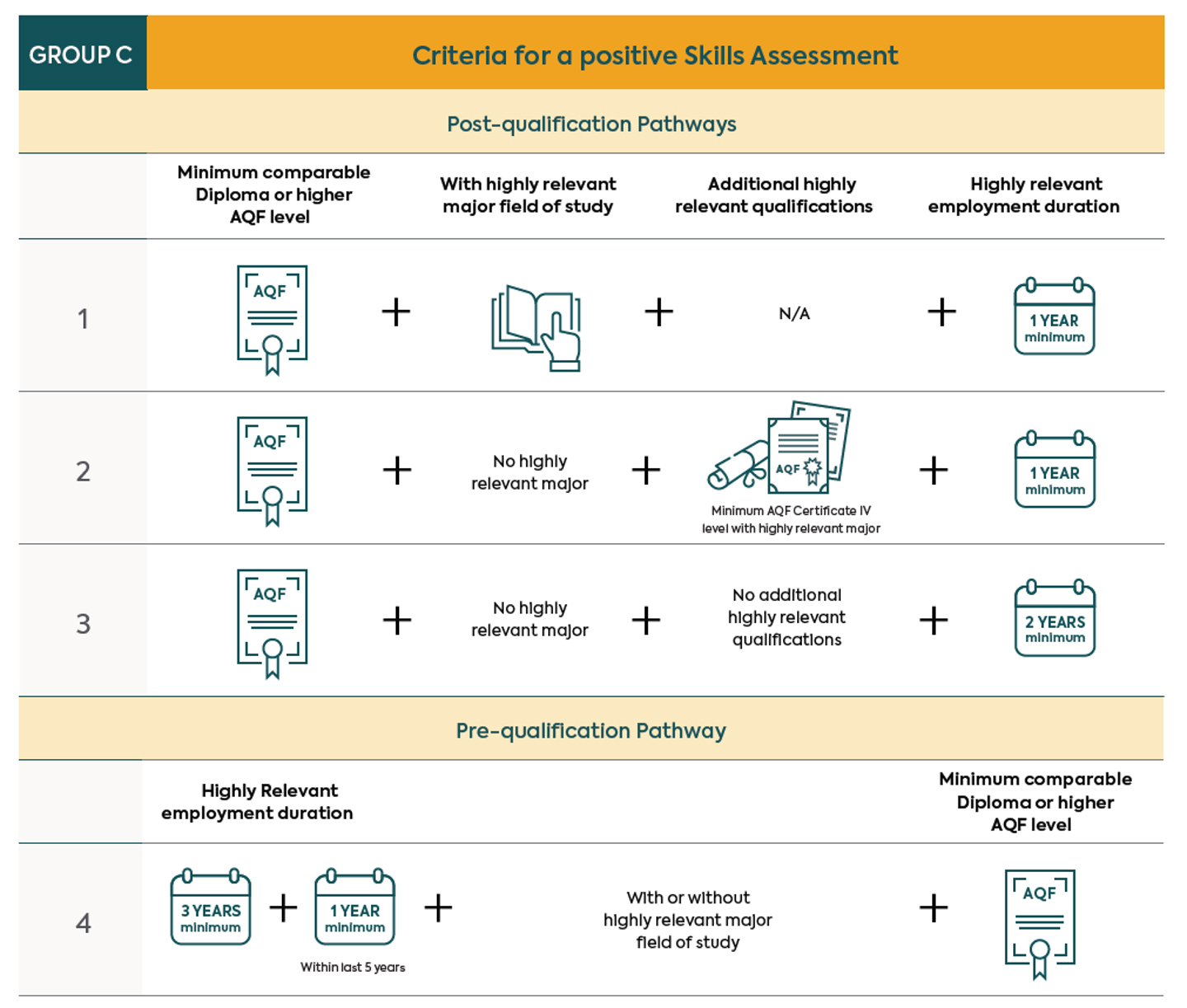
Description of Pathways
The information below describes the available pathways for a Skills Assessment under Group C. Please note that in order to achieve a successful Skills Assessment Outcome, a suitable assessment for both qualifications and employment is required.
Pathway 1
This pathway requires a qualification assessed as comparable to the education level of an Australian Qualifications Framework (AQF) Diploma or higher and in a field highly relevant to the nominated occupation.
Diploma or higher includes AQF Advanced Diploma, Associate Degree, Bachelor Degree, Graduate Diploma, Master Degree or Doctoral Degree.
In addition, it is essential for applicants to meet the following employment criteria:
- at least one year of post-qualification employment at an appropriate skill level, undertaken in the last five years,
- working 20 hours or more per week, and
- highly relevant to the nominated occupation.
Pathway 2
This pathway requires a qualification assessed as comparable to the education level of an Australian Qualifications Framework (AQF) Diploma or higher and in a field not highly relevant to the nominated occupation.
Diploma or higher includes AQF Advanced Diploma, Associate Degree, Bachelor Degree, Graduate Diploma, Master Degree or Doctoral Degree.
An additional qualification in a highly relevant field of study at a minimum AQF Certificate IV level is required. Additional qualifications in a highly relevant field of study include those comparable to the AQF Certificate IV.
In addition, it is essential for applicants to meet the following employment criteria:
- at least one year of post-qualification employment at an appropriate skill level, undertaken in the last five years,
- working 20 hours or more per week, and
- highly relevant to the nominated occupation.
For example, an applicant for the occupation Program or Project Administrator completed a non-relevant AQF Diploma qualification in April 2024 and later completed an AQF Certificate IV in Project Management in May 2026. The applicant commenced employment with the organisation in May 2024 and remains employed there.
Under Pathway 2, the applicant satisfies the minimum educational requirement for a Group C occupation through the AQF Diploma qualification. Accordingly, employment is counted from the completion date of the Diploma qualification, meaning employment from May 2024 onwards may be considered toward both the required Qualifying Period (QP) and any remaining eligible period for the points test.
As the later Certificate IV qualification is highly relevant to the occupation, the applicant may access the reduced employment requirement applicable under Pathway 2. In this case, only one year of QP is required, and that employment may be counted from the post-Diploma period rather than from the Certificate IV qualification completion date.
Pathway 3
This pathway requires a qualification assessed as comparable to the education level of an Australian Qualifications Framework (AQF) Diploma or higher and in a field not highly relevant to the nominated occupation.
Diploma or higher includes AQF Advanced Diploma, Associate Degree, Bachelor Degree, Graduate Diploma, Master Degree or Doctoral Degree.
In addition, it is essential for applicants to meet the following employment criteria:
- at least two years of post-qualification employment at an appropriate skill level, undertaken in the last five years,
- working 20 hours or more per week, and
- highly relevant to the nominated occupation.
Pathway 4
This pathway requires a qualification assessed as comparable to the education level of an Australian Qualifications Framework (AQF) Diploma or higher with or without a highly relevant major field of study to the nominated occupation.
Diploma or higher includes AQF Advanced Diploma, Associate Degree, Bachelor Degree, Graduate Diploma, Master Degree or Doctoral Degree.
In addition, it is essential for applicants to meet the following employment criteria:
- at least four years of employment at an appropriate skill level that includes at least one year of highly relevant employment within the last five years before applying,
- working 20 hours or more per week, and
- highly relevant to the nominated occupation.
Qualification and Employment Criteria
Employment
Highly relevant tasks include:
- Contributing to the planning and review of office services, and setting priorities and office service standards;
- Allocating human resources, space and equipment;
- Assigning work to and monitoring work performance of staff;
- Managing records and accounts of the office;
- Liaising with Professionals to coordinate office business and to facilitate resolution of problems;
- Ensuring office equipment and supplies are maintained;
- Ensuring compliance with occupational health and safety regulations;
- Ensuring work complies with relevant government legislation, policies and procedures;
- Coordinating personnel activities such as hiring, promotions, performance management, payroll, training and supervision.
Employment information
Office Managers are responsible for the smooth and efficient operation of clerical and administrative tasks within an organisation. Office Managers oversee the work of clerical and administrative personnel and coordinate administrative matters such as office supplies, workspace management, and occupational health and safety issues within the office space.
Personal Assistants and Secretaries are classified elsewhere in ANZSCO Minor Group 521, and perform organisational, clerical, secretarial and other administrative tasks in support of Managers and Professionals.
Please note:
Practice Managers are classified elsewhere under ANZSCO Unit Group 5122. Practice Managers organise and control the functions and resources of professional practices such as administrative systems and practice personnel.
Supporting material for assessment
Applicants nominating this managerial occupation must submit an organisational chart. An organisational chart should include:
- The company letterhead,
- Your job position,
- The job position of your superiors and subordinates, as well as,
- All positions reporting to your immediate supervisor and to your direct subordinates.
If you are unable to obtain an organisational chart from your employer, please provide a statutory declaration outlining the required information and the reasons why this information cannot be provided.
Get Support
Help with a Skills Assessment
Skills Assessment Support (SAS) services are for migration agents, legal practitioners and prospective applicants who are yet to submit their Skills Assessment application to VETASSESS.
Help with an urgent application
For general and professional occupations, priority processing can be used to fast-track urgent applications
How to apply
If you're a professional choosing to migrate to Australia, chances are you're likely to be assessed by us. We assess 361 different professional occupations, assessing your skills, experience and qualifications.
Find
Find the VETASSESS occupation that most closely fits your skills and experience.
Match
Match your skills and experience to your chosen occupation.
Prepare
Get ready to apply by preparing all the information and documents you need.
Apply
Apply online when you’re ready. If you’re still unsure, skills assessment support is available when you need it.