Other Sports Coaches or Instructors coach, train and instruct participants in other sports by analysing their performances and developing their abilities.
Occupation description
Other Sports Coaches or Instructors coach, train and instruct participants in other sports by analysing their performances and developing their abilities.
Occupations considered suitable under this ANZSCO code:
- Basketball Coach
- Cricket Coach
- Football Coach
- Martial Arts Instructor
- Sports Trainer
- Windsurfing Instructor
Occupations not considered under this ANZSCO code:
- Diving Instructor (Open Water)
- Gymnastics Coach or Instructor
- Horse Riding Coach or Instructor
- Snowsport Instructor
- Swimming Coach or Instructor
- Tennis Coach
- Dog or Horse Racing Official
- Sports Development Officer
- Sports Umpire
- Other Sports Official
- Footballer
- Sportspersons nec
- Fitness Instructor
These occupations are classified elsewhere in ANZSCO.
Other Sports Coach or Instructor is a VETASSESS Group F occupation
Applicants must have fulfilled at least one of the following three criteria (1-3)
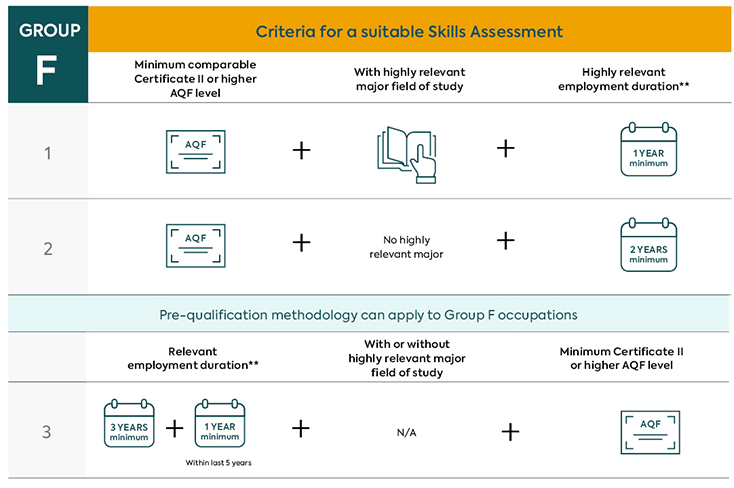
Description of Pathways
The information below describes the available pathways for a Skills Assessment under Group F. Please note that in order to achieve a suitable Skills Assessment Outcome, a suitable assessment for both qualifications and employment is required.
Pathway 1
This pathway requires a qualification assessed as comparable to the education level of an Australian Qualifications Framework (AQF) Certificate II or higher and in a field highly relevant to the nominated occupation.
Certificate II or higher includes AQF Certificate III, Certificate IV, Diploma, Advanced Diploma, Associate Degree, Bachelor Degree, Graduate Diploma, Master Degree or Doctoral Degree.
In addition, it is essential for applicants to meet the following employment criteria:
- at least one year of post-qualification employment at an appropriate skill level, undertaken in the last five years,
- working 20 hours or more per week, and
- highly relevant to the nominated occupation.
Pathway 2
This pathway requires a qualification assessed as comparable to the education level of an Australian Qualifications Framework (AQF) Certificate II or higher and in a field not highly relevant to the nominated occupation.
Certificate II or higher includes AQF Certificate III, Certificate IV, Diploma, Advanced Diploma, Associate Degree, Bachelor Degree, Graduate Diploma, Master Degree or Doctoral Degree.
In addition, it is essential for applicants to meet the following employment criteria:
- at least two years of post-qualification employment at an appropriate skill level, undertaken in the last five years,
- working 20 hours or more per week, and
- highly relevant to the nominated occupation.
Pathway 3
This pathway requires a qualification assessed as comparable to the education level of an Australian Qualifications Framework (AQF) Certificate II or higher with or without a highly relevant major field of study to the nominated occupation.
Certificate II or higher includes AQF Certificate III, Certificate IV, Diploma, Advanced Diploma, Associate Degree, Bachelor Degree, Graduate Diploma, Master Degree or Doctoral Degree.
In addition, it is essential for applicants to meet the following employment criteria:
- at least four years of employment at an appropriate skill level that includes at least one year of highly relevant employment within the last five years before applying,
- working 20 hours or more per week, and
- highly relevant to the nominated occupation.
Qualification and Employment Criteria
Qualification
AQF Certificate II or higher qualification*
This occupation requires a qualification in Sports Coaching and Development.
Highly relevant units of study may include, but are not limited to:
- Sport and Recreation Industry
- Sports Coaching and Administration
- Sport and Exercise Science
- Coaching Techniques and Strategies
- Fitness Program Development
- Sport Rules and Regulations
- First Aid
- Health and Safety Policies and Procedures
- Business Technology
- Strength and Conditioning**
*This includes qualifications assessed at AQF Certificate III, Certificate IV, Diploma, Associate Degree, Bachelor, Master and Doctoral level.
**Academic studies in Strength and Conditioning should be substantiated by documented evidence of professional engagement in sports coaching, which may be included in a cover letter or logbook.
A positive assessment of both qualification level and employment duration is required for a positive Skills Assessment Outcome. Highly relevant employment cannot compensate for lack of a qualification at the required educational level for the nominated occupation.
Short courses or qualifications awarded after a day or a week in duration would generally not be assessed as comparable to an AQF Certificate II. The volume of learning for an AQF Certificate II requires completion typically between 6 months to a year.
For example, a 5-hour course in foundation coaching awarded by a professional organisation may be provided as additional evidence in support of an application, however it will not meet the formal educational requirement of an AQF Certificate II qualification.
Employment
Highly relevant tasks include:
- Creating engaging and challenging environments which allow sportspersons to have a positive experience
- Coaching, training and instructing sportspersons by analysing performances and developing abilities;
- Planning and facilitating game strategies, developing play patterns and analysing game progress and performance;
- Motivating sportspersons and supervising practice sessions;
- Recruiting players and other coaching staff;
- Arranging entries into sporting competitions;
- Promoting sports and skills development, and overseeing the participation of young people in sport;
- Officiating at sporting events to enforce rules;
- Coordinating and directing sporting activities, and liaising with other stakeholders (e.g. other coaches, officials, support staff, parents) to interpret and enforce rules and regulations relating to sport.
Employment information
Sports Coaches are employed by sporting clubs and associations, government agencies, government funded centres (such as the Australian Institute of Sport, state, territory or regional institutes or academies of sport), holiday resorts and centres specialising in particular sports, health clubs, community institutions and educational institutions (schools and tertiary, for example). They may also be self-employed.
Employment must be highly relevant
Applicants nominating this occupation are required to specify exactly which sport they are coaching – whether from the list of ANZSCO specialisations or other.
If applicants coach more than one sport, additional evidence to support the applicant’s level of professional competency and expertise in each of these areas may be required.
To receive a positive assessment outcome, applicants must be able to demonstrate they are employed and paid to coach a sport for at least 20 hours per week. For applicants who are employed on a casual or parttime basis, additional official documentation such as a summary of the number of working hours per week may be required. Applicants must be able to demonstrate that their primary engagement with their employer is for the purposes of coaching. Therefore, for applicants occupying dual roles, official contracts and /or appointment letters outlining primary tasks and working hours per week may be required.
Employment must be paid
For skills assessment purposes, full-time work is paid employment performed for a minimum of 20 hours per week. Irregular periods that average out to 20 hours per week over a year will not be considered. For example, if an applicant has worked in their nominated occupation for 12 hours per week over a three-month period, and has then worked 40 hours per week over a seven month period, only the seven-month period would be considered for skills assessment purposes.
Supporting material for assessment
Applicants nominating for this occupation are advised to provide any additional evidence to support employment claims, such as:
- professional development certificates
- coaching awards / achievements
- cover letter or coaching logbook**
** A cover letter or coaching logbook should detail your coaching activities (such as session goal, coaching techniques, session summary, feedback, action plan, and follow-up), helping you keep track of your hours completed in various contexts over a designated period. This may include working with different athletes, sports, and mentors.
Note: The above supporting materials are considered as supplementary evidence and will not substitute a formal educational qualification or highly relevant employment.
Self-employment
If you are self-employed, you are required to provide the following:
a) Evidence of self-employment such as sole trading or business registration details and /or official statements issued by your (registered) Accountant and /or legal team. The statement from your Accountant or Solicitor must include the Accountant’s or Solicitor’s letterhead, your full name, how long you have been continuously self-employed including official dates in each role, the nature of the business conducted, the signature and contact details of the Accountant or Solicitor.
b) A statutory declaration listing your main duties during self-employment.
c) Payment evidence showing regular income from self-employment, such as client invoices together with corresponding bank statements and /or official taxation records.
d) Supplementary evidence, such as contracts with clients or suppliers, client testimonials, evidence of projects completed, etc.
Get Support
Help with a Skills Assessment
Skills Assessment Support (SAS) services are for migration agents, legal practitioners and prospective applicants who are yet to submit their Skills Assessment application to VETASSESS.
Help with an urgent application
For general and professional occupations, priority processing can be used to fast-track urgent applications
How to apply
If you're a professional choosing to migrate to Australia, chances are you're likely to be assessed by us. We assess 361 different professional occupations, assessing your skills, experience and qualifications.
Find
Find the VETASSESS occupation that most closely fits your skills and experience.
Match
Match your skills and experience to your chosen occupation.
Prepare
Get ready to apply by preparing all the information and documents you need.
Apply
Apply online when you’re ready. If you’re still unsure, skills assessment support is available when you need it.