Regulatory Affairs Managers plan, organise, direct, control, coordinate and promote adherence to regulatory frameworks and strategies within an organisation. They monitor regulatory environments and enable compliance.
Occupation description
Regulatory Affairs Managers plan, organise, direct, control, coordinate and promote adherence to regulatory frameworks and strategies within an organisation. They monitor regulatory environments and enable compliance.
Occupations considered suitable under this ANZSCO code:
- Regulatory Lead
- Regulatory Specialist
- Medical Affairs Advisor
- Regulatory Scientist
- Regulatory and Technical Affairs Associate
Occupations not considered under this ANZSCO code:
Quality Assurance Manager
These occupations are classified elsewhere in ANZSCO or are not at the required skill level.
Regulatory Affairs Manager is a VETASSESS Group B occupation
This occupation requires a qualification assessed as comparable to the educational level of an Australian Qualifications Framework (AQF) Bachelor degree or higher.
Applicants must have fulfilled at least one of the following four criteria (1–4):
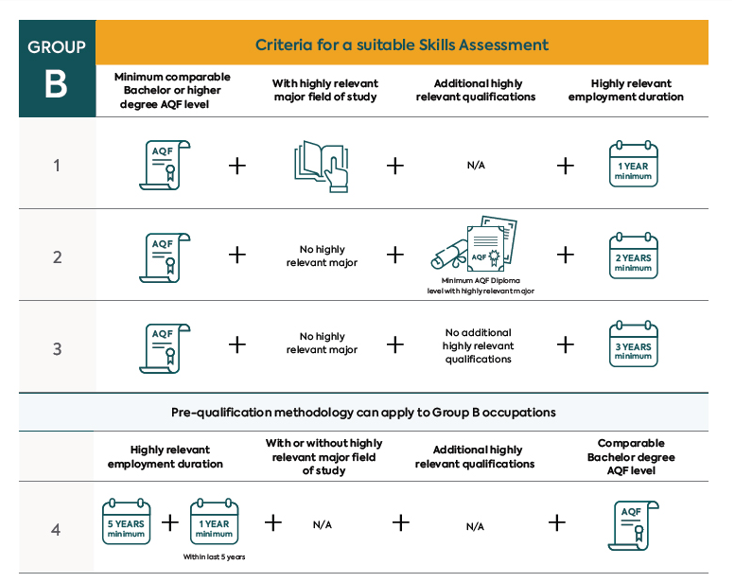
Description of Pathways
The information below describes the available pathways for a Skills Assessment under Group B. Please note that in order to achieve a suitable Skills Assessment Outcome, a positive assessment for both qualifications and employment is required.
Pathway 1
This pathway requires a qualification assessed as comparable to the education level of an Australian Qualifications Framework (AQF) Bachelor degree or higher degree and in a field highly relevant to the nominated occupation.
Bachelor degree or higher degree includes AQF Master Degree or AQF Doctoral Degree.
In addition, it is essential for applicants to meet the following employment criteria:
- at least one year of post-qualification employment at an appropriate skill level, undertaken in the last five years,
- working 20 hours or more per week, and
- highly relevant to the nominated occupation.
Pathway 2
This pathway requires a qualification assessed as comparable to the education level of an Australian Qualifications Framework (AQF) Bachelor degree or higher degree and in a field not highly relevant to the nominated occupation.
Bachelor degree or higher degree includes AQF Master Degree or AQF Doctoral Degree.
An additional qualification in a highly relevant field of study at a minimum AQF Diploma level is required. Additional qualifications in a highly relevant field of study include those comparable to the AQF Diploma or AQF Advanced Diploma or AQF Associate Degree or AQF Graduate Diploma.
In addition, it is essential for applicants to meet the following employment criteria:
- at least two years of post-qualification employment at an appropriate skill level, undertaken in the last five years,
- working 20 hours or more per week, and
- highly relevant to the nominated occupation.
For example, an applicant for the occupation Quality Assurance Manager completed a non-relevant AQF Bachelor qualification in April 2024 and later completed an AQF Diploma in Quality Management in May 2026. The applicant commenced employment with the organisation in May 2024 and remains employed there.
Under Pathway 2, the applicant satisfies the minimum educational requirement for a Group B occupation through the AQF Bachelor qualification. Accordingly, employment is counted from the completion date of the Bachelor qualification, meaning employment from May 2024 onwards may be considered toward both the required Qualifying Period (QP) and any remaining eligible period for the points test.
As the later Diploma qualification is highly relevant to the occupation, the applicant may access the reduced employment requirement applicable under Pathway 2. In this case, only two years of QP are required, and that employment may be counted from the post-Bachelor period rather than from the Diploma qualification completion date.
Pathway 3
This pathway requires a qualification assessed as comparable to the education level of an Australian Qualifications Framework (AQF) Bachelor degree or higher degree and in a field not highly relevant to the nominated occupation.
Bachelor degree or higher degree includes AQF Master Degree or AQF Doctoral Degree.
In addition, it is essential for applicants to meet the following employment criteria:
- at least three years of post-qualification employment at an appropriate skill level, undertaken in the last five years,
- working 20 hours or more per week, and
- highly relevant to the nominated occupation.
Pathway 4
This pathway requires a qualification assessed as comparable to the education level of an Australian Qualifications Framework (AQF) Bachelor degree or higher degree with or without a highly relevant major field of study to the nominated occupation.
Bachelor degree or higher degree includes AQF Master Degree or AQF Doctoral Degree.
In addition, it is essential for applicants to meet the following employment criteria:
- at least six years of employment at an appropriate skill level that includes at least one year of highly relevant employment within the last five years before applying,
- working 20 hours or more per week, and
- highly relevant to the nominated occupation.
Qualifications & employment criteria
Qualification
AQF Bachelor Degree or higher
This occupation requires a qualification in a field of high relevance to the occupational specialisation.
While there is no specific qualification in regulatory affairs, typical examples of highly relevant majors include (but are not limited to):
- Natural Science (Biotechnology, Biology, Chemistry, Molecular Biology, Biomedical Engineering, or a related field)
- Engineering
- Materials Science
- Agriculture
- Pharmaceutical Science
- Medical Science / Medicine
- Quality study/Quality management
- Health Science /Allied health
- Disciplines such as Business / Finance or others which are relevant to the employment context may be considered on a case-by-case basis (if employment is highly relevant)
Regulatory Affairs Managers may undertake professional development through industry-recognised courses or certifications offered by organizations such as ARCS Australia, TOPRA (The Organisation for Professionals in Regulatory Affairs), RAPS (Regulatory Affairs Professionals Society), and DIA (Drug Information Association). These credentials are highly regarded within the industry as evidence of expertise and commitment to the profession and may be considered as supporting evidence; they cannot, however, be assessed towards meeting the formal qualification requirements of this occupation as they are not generally comparable to the Australian Qualifications Framework.
Employment
Highly relevant tasks include:
- Developing and monitoring regulatory policies, procedures and strategies.
- Preparing, reviews and submitting regulatory documents and applications to regulatory agencies.
- Providing regulatory guidance and coordinating with other departments within an organisation to ensure that products and services are compliant with relevant regulations.
- Managing regulatory activities such as regulatory risks/audits, regulatory agency inspections or product recalls.
- Monitoring changes in the regulatory environment to determine potential impacts on organisational processes.
Other tasks include:
- Ensuring products meet local and international regulations before they reach the market, and for the duration of their lifecycle responsibility for the authoring and ownership of Standard Operating procedures (SOPs) and other guidance documents as required.
- Communicating with regulatory agencies/authorities e.g. Medsafe (New Zealand), TGA (Australia), FDA (U.S.A.), EMA (Europe), CDSCO (India,), DRAP (Pakistan), APRA/ASIC/ACCC (Australia).
- Advising on the best approaches to gain product approvals efficiently.
- Act as primary interface with local authorities and industry groups, and trade associations, representing the company's regulatory interests and fostering positive relationships.
- Compiling technical files, safety data, maintaining technical documentation e.g. For Pharma and MedTech, overseeing preparation, submission, lifecycle management of regulatory dossiers (e.g., new listings, variations, renewals) and other relevant regulatory documents).
- Keeping up with evolving laws and ensuring business compliance.
Educating staff about regulatory requirements and developing internal compliance guidelines.
Employment Information
Regulatory Affairs Managers oversee and manage regulatory processes to ensure the organisation’s products comply with all relevant regulatory standards
Regulatory Affairs Managers can work in:
- Pharmaceutical & Biotechnology Companies (Regulatory submissions, drug approvals)
- Medical Device Manufacturers (Compliance with safety and efficacy regulations)
- Cosmetic & Chemical Industries (Safety and ingredient regulations)
- Food & Beverage Industry (Labelling, safety, and import/export regulations)
- Government & Regulatory Agencies (Developing and enforcing regulations)
- Consulting Firms (Providing compliance advice to companies)
- Banking, Insurance and Financial firms (Providing advice, insight and guidance on regulatory issues / Prudential standards and engagements)
As Regulatory Affairs Managers, they typically oversee a team of professionals, such as:
- Regulatory Affairs Associates/Senior Associates
- Compliance Officers
- Quality Assurance Specialists
- Pharmacovigilance Associates/specialists
- Technical Writers (for regulatory documents)
Note: It is noted that different organisations will have different career ladder levels associated with the ‘Manager’ position.
Supporting material for assessment
Applicants nominating this managerial occupation must submit an organisational chart. An organisational chart should include:
- The company letterhead,
- Your job position,
- The job position of your superiors and subordinates, as well as,
- All positions reporting to your immediate supervisor and to your direct subordinates.
If you are unable to obtain an organisational chart from your employer, please provide a statutory declaration outlining the required information and the reasons why this information cannot be provided.
Get Support
Help with a Skills Assessment
Skills Assessment Support (SAS) services are for migration agents, legal practitioners and prospective applicants who are yet to submit their Skills Assessment application to VETASSESS.
Help with an urgent application
For general and professional occupations, priority processing can be used to fast-track urgent applications
How to apply
If you're a professional choosing to migrate to Australia, chances are you're likely to be assessed by us. We assess 361 different professional occupations, assessing your skills, experience and qualifications.
Find
Find the VETASSESS occupation that most closely fits your skills and experience.
Match
Match your skills and experience to your chosen occupation.
Prepare
Get ready to apply by preparing all the information and documents you need.
Apply
Apply online when you’re ready. If you’re still unsure, skills assessment support is available when you need it.