Sports Development Officer promotes sports and skills development, and oversees the participation of young people and other special groups in sport.
Occupation description
Sports Development Officer promotes sports and skills development, and oversees the participation of young people and other special groups in sport.
Occupations not considered under this ANZSCO code:
- Diving Instructor (Open Water)
- Gymnastics Coach or Instructor
- Horse Riding Coach or Instructor
- Snowsport Instructor
- Swimming Coach or Instructor
- Tennis Coach
- Dog or Horse Racing Official
- Sports Umpire
- Other Sports Official
- Other Sports Coach or Instructor
- Sportspersons nec
- Fitness Instructor
- Outdoor Adventure Guides
- Sports Administrator
These occupations are classified elsewhere in ANZSCO
Sports Development Officer is a VETASSESS Group C occupation
This occupation requires a qualification assessed as comparable to the educational level of an Australian Qualifications Framework (AQF) Diploma or higher.
Applicants can fulfil the assessment criteria for this occupation in four different ways.
*If employment is prior to the completion of the qualification at the required level, an applicant must have at least one year of highly relevant employment at an appropriate skill level within the last five years. The remaining three years of pre-qualifying period may be within the last ten years.
A positive assessment of both qualification level and employment duration is required for a positive Skills Assessment outcome.
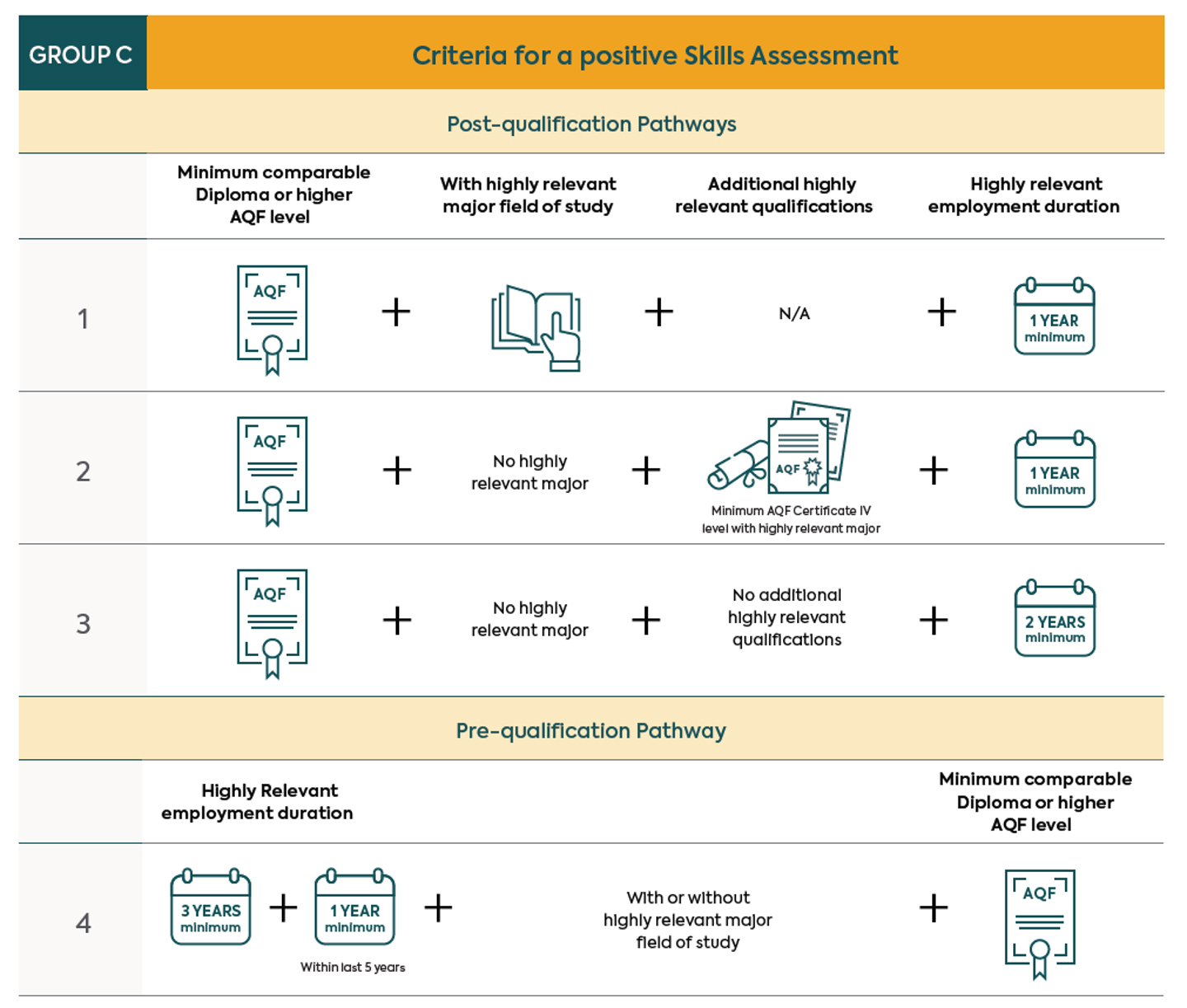
Description of Pathways
The information below describes the available pathways for a Skills Assessment under Group C. Please note that in order to achieve a successful Skills Assessment Outcome, a suitable assessment for both qualifications and employment is required.
Pathway 1
This pathway requires a qualification assessed as comparable to the education level of an Australian Qualifications Framework (AQF) Diploma or higher and in a field highly relevant to the nominated occupation.
Diploma or higher includes AQF Advanced Diploma, Associate Degree, Bachelor Degree, Graduate Diploma, Master Degree or Doctoral Degree.
In addition, it is essential for applicants to meet the following employment criteria:
- at least one year of post-qualification employment at an appropriate skill level, undertaken in the last five years,
- working 20 hours or more per week, and
- highly relevant to the nominated occupation.
Pathway 2
This pathway requires a qualification assessed as comparable to the education level of an Australian Qualifications Framework (AQF) Diploma or higher and in a field not highly relevant to the nominated occupation.
Diploma or higher includes AQF Advanced Diploma, Associate Degree, Bachelor Degree, Graduate Diploma, Master Degree or Doctoral Degree.
An additional qualification in a highly relevant field of study at a minimum AQF Certificate IV level is required. Additional qualifications in a highly relevant field of study include those comparable to the AQF Certificate IV.
In addition, it is essential for applicants to meet the following employment criteria:
- at least one year of post-qualification employment at an appropriate skill level, undertaken in the last five years,
- working 20 hours or more per week, and
- highly relevant to the nominated occupation.
For example, an applicant for the occupation Program or Project Administrator completed a non-relevant AQF Diploma qualification in April 2024 and later completed an AQF Certificate IV in Project Management in May 2026. The applicant commenced employment with the organisation in May 2024 and remains employed there.
Under Pathway 2, the applicant satisfies the minimum educational requirement for a Group C occupation through the AQF Diploma qualification. Accordingly, employment is counted from the completion date of the Diploma qualification, meaning employment from May 2024 onwards may be considered toward both the required Qualifying Period (QP) and any remaining eligible period for the points test.
As the later Certificate IV qualification is highly relevant to the occupation, the applicant may access the reduced employment requirement applicable under Pathway 2. In this case, only one year of QP is required, and that employment may be counted from the post-Diploma period rather than from the Certificate IV qualification completion date.
Pathway 3
This pathway requires a qualification assessed as comparable to the education level of an Australian Qualifications Framework (AQF) Diploma or higher and in a field not highly relevant to the nominated occupation.
Diploma or higher includes AQF Advanced Diploma, Associate Degree, Bachelor Degree, Graduate Diploma, Master Degree or Doctoral Degree.
In addition, it is essential for applicants to meet the following employment criteria:
- at least two years of post-qualification employment at an appropriate skill level, undertaken in the last five years,
- working 20 hours or more per week, and
- highly relevant to the nominated occupation.
Pathway 4
This pathway requires a qualification assessed as comparable to the education level of an Australian Qualifications Framework (AQF) Diploma or higher with or without a highly relevant major field of study to the nominated occupation.
Diploma or higher includes AQF Advanced Diploma, Associate Degree, Bachelor Degree, Graduate Diploma, Master Degree or Doctoral Degree.
In addition, it is essential for applicants to meet the following employment criteria:
- at least four years of employment at an appropriate skill level that includes at least one year of highly relevant employment within the last five years before applying,
- working 20 hours or more per week, and
- highly relevant to the nominated occupation.
Qualification & Employment criteria
Qualification
Sports development is a field of study which is concerned with the provision and enhancement of opportunities to participate in sport and to develop performance and enjoyment of sport and physical activity.
This occupation requires a qualification assessed as comparable to the education level of an Australian Qualifications Framework (AQF) Diploma or higher and in a field highly relevant to the nominated occupation.
Subjects in this field may include:
• Sport Management
• Sports Coaching and Administration
• Sport and Recreation
• Sports and Events Management
• Sport Organisation
• Sports Development and Policy
• Community Sport Leadership
• Sport in Society
• Contemporary Issues in Sport Business
• Principles of Behaviour in Physical Activity
• Sport and Exercise Psychology
• Professional Preparation
• Sport and the Law
• Research and Analysis in Health
• Sport Marketing
Employment Criteria
Highly relevant tasks include, but are not limited to:
- Promotes sports and skills development and oversees the participation of young people in sport.
- Gathers information to increase the understanding of community sport and recreational issues
- Develops partnerships with governing bodies, councils, and organisations
- Develops and coordinates the delivery of sport and recreation programs, services and initiatives to address equity, social justice and community issues
- Ensures inclusivity and accessibility in sports participation
- Provides administrative and organisational support to schools or sporting clubs
- Secures funding and grants for sports projects
- Manages the finances of approved programs and projects including the administration of grant programs
- Advises teachers and coaches, conducts coaching clinics and training camps, and gives out information and materials from sporting bodies
Additional Tasks:
- May develop training exercises to improve skills
- May act as coach of individuals or teams in representative competitions
- May act as a talent scout for clubs with parent sporting bodies
- May schedule competitions and arrange and allocate venues
Employment Information
Sports Development Officers play a key role in promoting and increasing participation in sports and physical activities within communities. They develop sports programs, support grassroots initiatives, and ensure inclusivity in sports by engaging people of all ages, backgrounds, and abilities. By promoting participation, they help improve physical health, mental well-being, and social integration. They connect with local communities, sports organisations and schools to build partnerships.
Sports Development Officers are employed by sporting clubs / sporting associations, sport’s governing bodies, local government and councils, government-funded centres (such as the Australian Institute of Sport, state, territory, or regional institutes or academies of sport). They may also be self-employed.
Note: Applicants nominating this occupation are required to specify the sport they are promoting – whether from the list of ANZSCO specialisations or other.
Supporting material for assessment
Applicants nominating for this occupation are advised to provide any additional evidence to support employment claims, such as:
· professional development certificates
· cover letter to explain your role and a record of the sport programs you are running or promoting
Note: The above supporting materials are considered as supplementary evidence and will not substitute a formal educational qualification or highly relevant employment.
Get Support
Help with a Skills Assessment
Skills Assessment Support (SAS) services are for migration agents, legal practitioners and prospective applicants who are yet to submit their Skills Assessment application to VETASSESS.
Help with an urgent application
For general and professional occupations, priority processing can be used to fast-track urgent applications
How to apply
If you're a professional choosing to migrate to Australia, chances are you're likely to be assessed by us. We assess 361 different professional occupations, assessing your skills, experience and qualifications.
Find
Find the VETASSESS occupation that most closely fits your skills and experience.
Match
Match your skills and experience to your chosen occupation.
Prepare
Get ready to apply by preparing all the information and documents you need.
Apply
Apply online when you’re ready. If you’re still unsure, skills assessment support is available when you need it.